
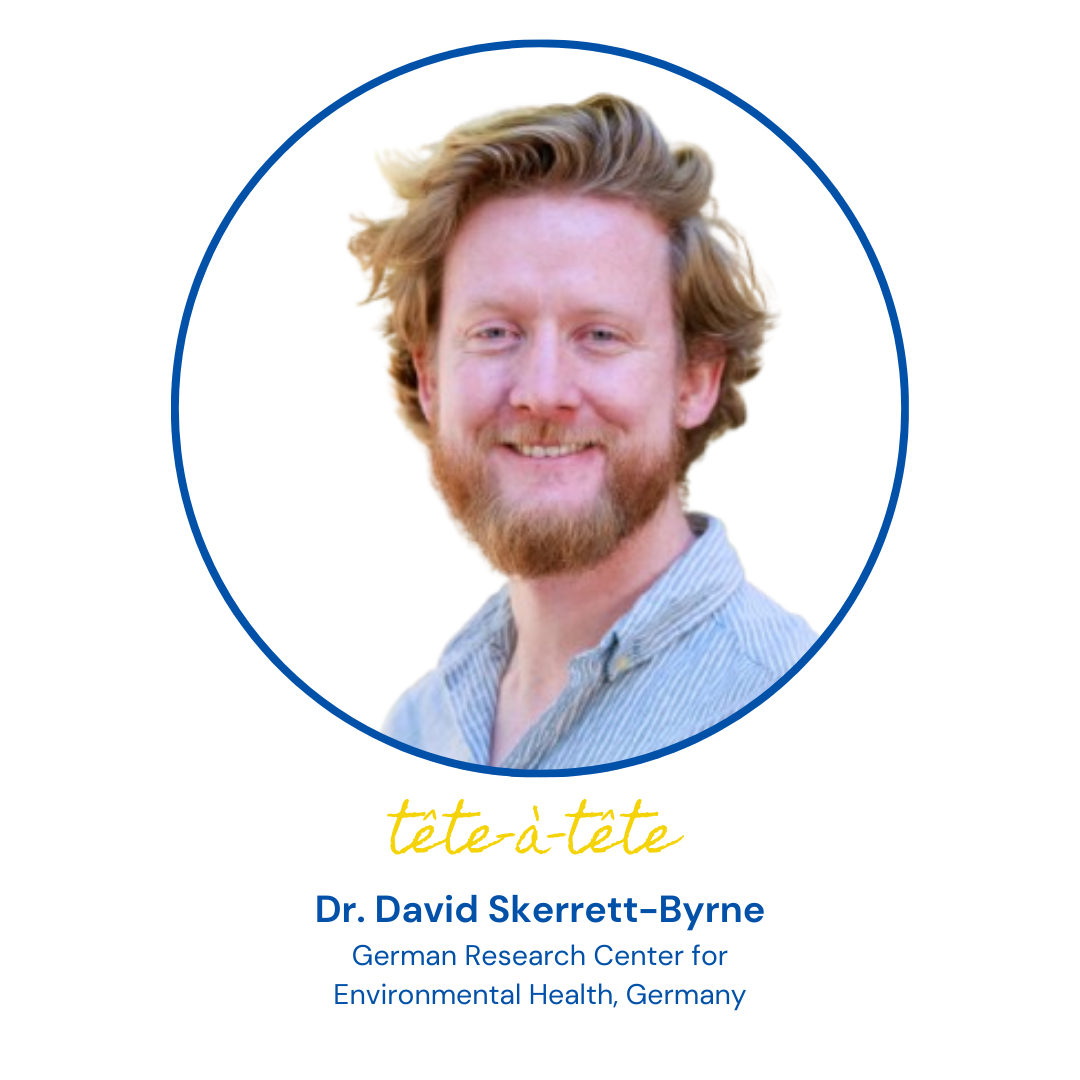
We are pleased to feature an interview with Dr. David Skerrett-Byrne, another speaker at the 18th NYRA Meeting. Based at the German Research Center for Environmental Health, his research explores how environmental stress and epigenetic signals shape sperm function, male fertility, and offspring health. With a strong focus on the epididymis, his work aims to redefine clinical andrology through new biomarkers, non-hormonal male contraceptives, and improved sperm selection strategies.
1. When and why did you decide to work in the field of reproductive biology?
I grew up endlessly curious about how things worked, which drew me into biology, physics and engineering. My PhD began in a very different place, studying cancer and exposing mice to cigarette smoke, where I developed deep expertise in proteomics. Those techniques unexpectedly provided a career-defining detour which took me to Queensland, Australia, where I found myself face-to-face with an 800 kg crocodile… to check out his sperm. That moment opened the door to the wild, complex, and surprisingly underexplored world of reproductive biology. It also showed me that you don’t have to be bound by the field of your PhD, if you carry strong, transferable skills, you can survive and thrive, in entirely new research landscapes. Since then, my central research has been a feminist endeavour; to shift the burden of reproductive responsibility, which has for too long fallen disproportionately on women, toward a shared model where men actively participate in family planning. To achieve this, I’m actively interested in developing male contraceptives, understanding what determines healthy sperm, and how our ever-changing environment and lifestyles affect sperm epigenetics, which in turn shapes the health trajectory of the next generation.
- Could you share a moment of challenge in your career, and the lessons you learned from it?
Like most researchers, I could point to grant rejections or tough reviews, but the most formative challenge came from moving halfway across the world to Australia early in my career. I arrived without an established community, navigating cultural differences while trying to prove myself scientifically. That experience taught me that success in research is not just about ideas or output, but about people. I learned how important it is to build genuine connections, to speak openly about challenges, and to invest in emotional intelligence, both in yourself and in those around you. Over time, those relationships became the foundation that helped me weather professional setbacks and take creative risks. It reshaped how I mentor students now, and how I think about leadership. Science is demanding, and no one thrives in it alone.
- What has been the greatest success in your career so far?
Without hesitation, my students! Watching them grow from hesitant or unsure early-career researchers into confident scientists, whether presenting their work, defending their ideas, and taking ownership of their research, has been the most rewarding part of my career thus far. Their successes, whether publishing a paper or standing on stage delivering a beautiful talk they once doubted they could give, brings me genuine moments of joy. Alongside this, being awarded a national fellowship during a period of shrinking research funding in Australia was a significant milestone. It represented trust in my ideas, my leadership, and my ability to build a research program spanning two maginificent cities, Munich and Melbourne. But even that achievement ultimately matters most because of what it enables, supporting young researchers and giving them the space to thrive.
- What advice would you give to young researchers?
If I had to choose one thing, it would be community. We often call it “networking”, but I don’t mean strategic conversations or collecting contacts. I mean genuinely getting to know people; their values, their motivations, and who they are beyond their publication list.
Those relationships become the people who champion you, challenge you, and support you when things don’t go to plan (which they often don’t). Being known, really known, matters more than being “flawless”. As Oscar Wilde famously put it, “There is only one thing in life worse than being talked about, and that is not being talked about.”. Science is a collective endeavour. Invest in your community early, generously, and authentically, it will sustain you far longer than any single paper or grant.