
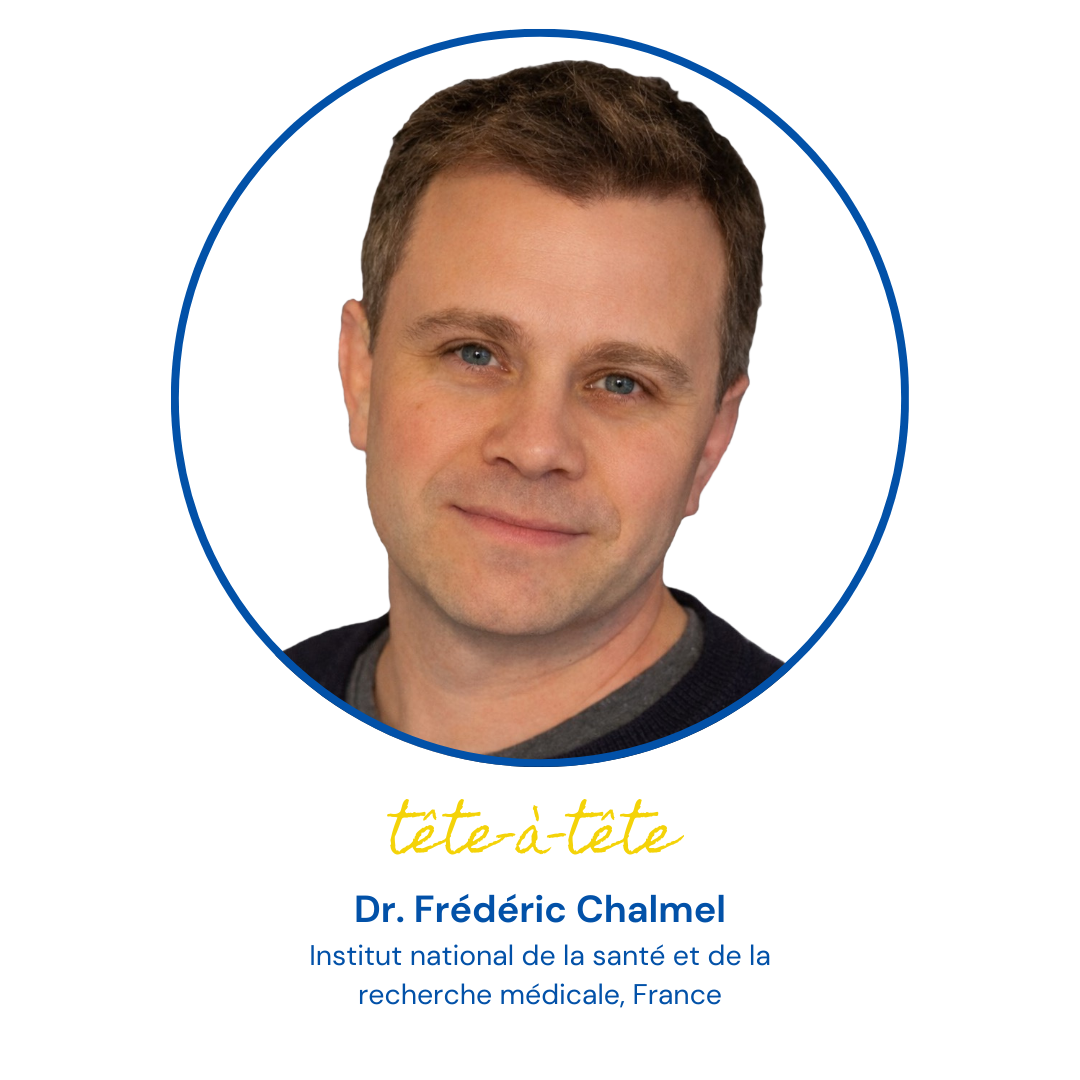
We’re excited to highlight another plenary speaker for the 18th NYRA Meeting: Dr. Frédéric Chalmel. He is a Research Scientist at Inserm and co-leads the UrGenT team (Physiology and Physiopathology of the Urogenital Tract) at the Irset Institute in Rennes. His research focuses on functional and integrative genomics, particularly transcriptomics, to study the development and physiology of the mammalian urogenital tract and the effects of xenobiotics on reproductive health.
- When and why did you decide to work in the field of reproductive biology?
To be honest, it happened almost by accident. During my PhD in genomics under Dr. Olivier Poch at IGBMC in Strasbourg, I worked on the characterization of a mouse model of retinal degeneration in collaboration with the late Dr. Thierry Léveillard at the Institut de la Vision in Paris, and at that time my plan was very clear: first, do a postdoc in transcriptomics to deepen my expertise in functional genomics, and then ideally rejoin Thierry Léveillard’s group in Paris. But life had other ideas. During my postdoc, which focused on the conservation of gene expression programs during mammalian spermatogenesis (Chalmel et al., 2007), I had the chance to work closely with Bernard Jégou, who became a true mentor for me. He introduced me not only to Rennes and Brittany, but above all to the beauty of testis physiology and development, and his enthusiasm was contagious. Against my original plans, I decided to join his research unit in Rennes in March 2007.
- Could you share a moment of challenge in your career, and the lessons you learned from it?
A scientific career is really a long succession of challenges, some ending in success, others in disappointment, because that is simply the nature of research. In my experience, the most difficult moments are rarely the scientific ones: uncertainty, failed hypotheses, and doubt are part of the job, and if you love science, you learn to live with them. The deeper challenges are often human ones, especially around recognition, authorship, and the tendency to see bioinformatics or genomics as mere service work or “button-pushing,” rather than as full scientific disciplines. The main lesson I learned is that you should never compromise on scientific integrity, never let politics decide authorship, and always make sure that the people who truly contributed are properly recognized. This should be obvious in science, but unfortunately it still needs to be defended, again and again.
- What has been the greatest success in your career so far?
Institutions often define success through publications and grants, and these things can fluctuate greatly from one period to another. But personally, when I look back, the greatest success of my career has been building a network of colleagues, collaborators, and friends with whom I truly enjoy working and thinking. For me, the most rewarding part of science is sharing ideas, designing new projects, moving forward collectively, and learning through discussion with others. These relationships are what keep motivation alive over the years, especially when science becomes difficult, competitive, or exhausting. Research is, before anything else, a collective human adventure. In the end, I think the people with whom you build science are one of the most meaningful measures of a career.
- What advice would you give to young researchers?
Research is a demanding world: it is difficult, competitive, and sometimes quite indifferent to your efforts, especially at the beginning. The truth is that no one is automatically waiting for your work, so part of your job is to remain convinced of its value and to learn how to explain clearly why it matters. To last in this career, you need to root your work in a collective, among people you respect, enjoy, and learn from. Build your path alongside colleagues, collaborators and mentors who help keep your curiosity, creativity, and passion alive, because these are the things that sustain you when motivation is tested. Science is not a sprint of isolated talent. Alone, you may go faster, but together, you go much further.